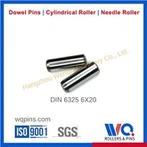
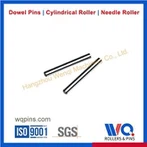
What are dowel pins?
If you've ever shopped at IKEA or assembled furniture yourself, you're familiar with the peg-shaped unthreaded wooden dowels, also known as dowels, used to connect parts together.
For manufacturing purposes, dowel pins are solid, headless cylindrical straight metal pins with a centerless finish. Typically hardened and manufactured to precise fractional diameters and lengths, dowel pins come in a variety of sizes, styles, designs and materials, causing buyer, engineer and end user confusion! Today, we'll try to simplify this confusing category of fasteners.
Who uses dowel pins?
Dowels are used as hinges, shafts or pivots to position or secure parts within precision assemblies or fixtures.
They are used in a wide variety of applications in many industries, including: aerospace, electrical, hydraulics, instrumentation, tools and fixtures, machinery, military, and more.
Dowel pins are popular in assemblies because they can withstand frequent insertion and removal without deforming. Production favors pins because they require no additional fastening hardware to insert, no secondary operations, and no mating parts. All of this adds up to speed up production, which makes everyone in the food chain happy!
What do I need to consider when choosing dowel pins?
Although dowel pins are available in a variety of materials and styles, there are several major issues to consider when it comes to major commercial and mil-spec products.
Standard, extra large or extra small?
Standard series locating pins are used for initial application. Their base diameter is 0.0002" higher than the nominal diameter. For example, a 1/4 standard pin has a diameter between 0.2501-.2503.
Oversized series dowel pins are commonly used to install into worn holes and are often used for aftermarket repairs. Their base diameter is 0.001 inches higher than the nominal diameter. For example, a 1/4 oversized pin has a diameter between 0.2509-.2511.
Undersized series locating pins are used for non-uniform holes. Their base diameter is -0.0002 inches below the nominal diameter. For example, a 1/4 undersized pin has a diameter of 0.2500-.2498. Mil-P-21143/2- is in the undersized category.
Chamfer or radius at the end?
Typically, commercial pins are manufactured to imperial standard ANSI ASME B18.8.2. Standard alloy pins have a radius on one end and a chamfer on the other. However, stainless steel dowels are usually chamfered on both ends.
Commercial or Military?
If you or your customers require domestically manufactured DFAR pins to meet the strictest standards, military pins may be the way to go!
Alloy or stainless steel? Which stainless steel?
Alloy steel is the strongest pin available and is hardened. It can be finished with black oxide to provide higher rust resistance than common alloys.
Type 416 stainless steel is the strongest standard stainless product and is the material used in the MS16555 and MS16556 series. Magnetic.
Type 18-8/303 stainless steel is the most commonly used stainless steel and is the standard material for the Mil-P-21143 series.
Type 316 stainless steel is the most corrosion-resistant stainless steel and is not associated with mil-spec parts.
Are there other factors to consider?
Pins are usually shown under their mil-spec number and can be crossed with commercial equivalents. Some common Mil-spec series used for dowel pins include Mil-P-21143 (303 stainless steel), MS16555 (standard series for alloy and 416 stainless steel), and MS16556 (oversized series for alloy and 416 stainless steel).
If you are not ordering by MS or NAS mil-spec part number, the English set pins conform to ANSI/ASME B18.8.2. For commercial pins, take care to specify the material and dimensional tolerances you need. Unless otherwise specified, dowel pins are precision ground, hardened and heat treated to the proper Rockwell hardness.
Remember, no hammer! When installing the dowel, do not force the pin into the hole, always press it in for best results.