
Latest Products


Contact Us
- Ningmu Vil., Ningwei, Xiaoshan, Hangzhou, Zhejiang, 311200, China
- wq@wqpins.com
- +8613967135209
Why Choose Us
Excellent Product Quality
The quality of our products and services is our number one priority. Quality control during every process.
Rich Experience In Production
More than 15 years' experience in the industrial makes us capable to manufacture the right product you need.
Best Service
Selling and delivering are not all part of business, our after-sales service will help you expand your business much easier.
Professional Team
We have a team of skilled professionals who are dedicated to providing exceptional customer service, ensuring that all your needs are met.
What is Cylindrical Rollers?
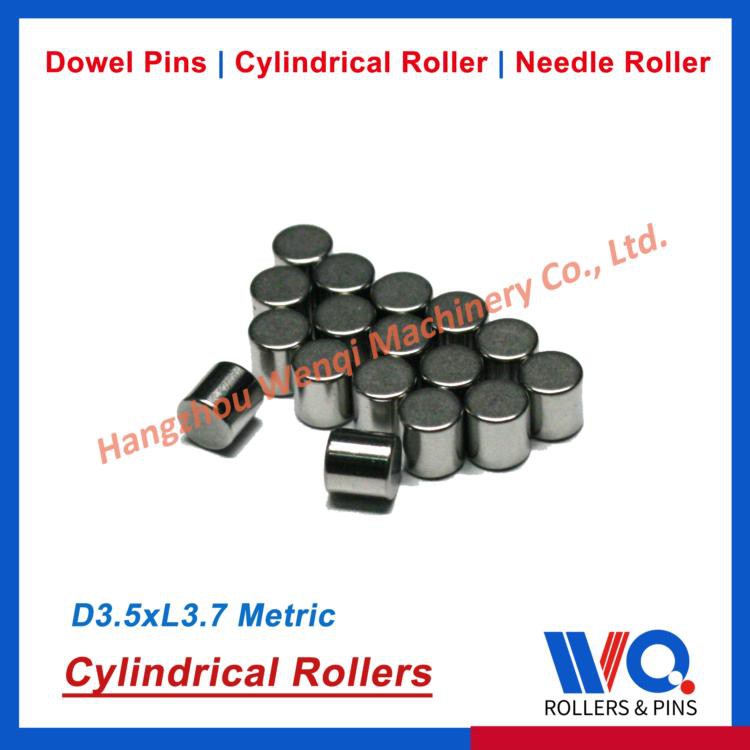
Cylindrical roller bearings (CRBs) have a simple structure of cylindrical rollers in linear contact with the raceways. They offer high load capacity under primarily radial loads. Low friction between the rollers and ring ribs makes these bearings suited for high speed rotation.
 Alloy Steel Cylindrical Rollers
Alloy Steel Cylindrical Rollers are made of alloy steel, which combines iron with elements like chromium, molybdenum, vanadium, or nickel to enhance strength, hardness, and wear resistance.
Add to Inquiry Cylindrical Roller Din5402-1
Cylindrical Rollers Din5402-1 are essential components in machinery and equipment that require reliable and efficient operation under demanding conditions.
Add to Inquiry Cylindrical Bearing Rollers
Diameter: 1.5 mm – 20 mm. Length 2.5 mm – 100 mm. Material: 100 Cr 6 (1.3505). Hardness: HRC 58 – 65 HRC.
Add to Inquiry Cylindrical Roller ZB
Cylindrical rollers are mainly used in bearings as rolling elements, they are made from alloy steel, have excellent surface finish, excellent hardness and high load carrying capacity.
Add to Inquiry-
Cylindrical Roller TR
Cylindrical rollers made from this material have excellent surface finish, excellent hardness and high load carrying capacity.
Add to Inquiry  Cylindrical Roller TP
Cylindrical Roller TP type. Size: 6.35x12.7. Material: 100Cr6. Hardness: HRC61-65
Add to Inquiry
As a leading manufacturer of cylindrical rollers, we take great pride in providing top-quality products to our customers. Our factory operates with the latest technology and equipment to ensure that our rollers are durable, reliable, and efficient. We understand the importance of delivering products that meet the exact specifications of our clients, and we work tirelessly to ensure that every order is produced to the highest standards.
At our factory, we have a team of experienced professionals who are committed to delivering exceptional service. Our staff members are highly skilled in their individual roles, and work collaboratively to ensure that each order is processed efficiently. We are able to support bulk orders, and welcome the opportunity to work with clients who require large quantities of our cylindrical rollers.
We understand that every client has unique needs, and we are committed to providing personalized service to meet those needs. We listen to our clients and work closely with them to ensure that their order is produced to their exact specifications. We believe that our success as a company relies on the success of our clients, and we are committed to working together to ensure that both parties achieve their goals.
Cylindrical rollers are normally manufactured according to DIN 5402-1. This DIN standard specifies dimensions and tolerances. Depending on the application, different profiles can be produced on the lateral surface.The spectrum of possibilities ranges from a purely cylindrical, to a cylindrical-crowned, to a logarithmic profile.
Uses of Cylindrical Rollers Bearings
The cylindrical roller bearings can be used in various types of mechanical systems. The different types of cylindrical roller bearings can offer different usages:
Axial Displacement
The bearings are designed to support axial loads and facilitate movement to and from axial directions within the machinery. The N and NU types of cylindrical roller bearings are perfect use cases for axial displacement, as single-row cylindrical roller bearings offer the scope of axial displacement in some limits relative to the housing.
Withstand Incidental Thrust Loads
The thrust load is a load that is applied parallel to the rotation of the axis. The NF, NJ, and NUP series of cylindrical roller bearings are designed in such a way as to withstand incidental thrust loads apart from radial loads.
Uses in Heavy Machinery and extreme systems
The cylindrical roller bearings are used in high-speed systems and can be deployed for high-performing systems such as agricultural machinery, wind turbines, mining machines, etc.

The rollers and the raceway are in line contact or trimmed line contact, with large radial bearing capacity, suitable for bearing heavy loads and impact loads.
The friction coefficient is small, suitable for high speed, and the limit speed is close to that of deep groove ball bearings.
N-type and NU-type can move axially, can adapt to changes in the relative position of the shaft and the shell caused by thermal expansion or installation errors, and can be used as free end supports.
The processing requirements for the shaft or seat hole are relatively high. After the bearing is installed, the relative deviation of the axis of the outer ring must be strictly controlled to avoid contact stress concentration.
The inner or outer ring can be separated for easy installation and removal
Why Choose a Cylindrical Rollers Bearing?
Cylindrical roller bearings are a popular choice among many engineers and professionals, and for good reasons. One of the standout features of cylindrical roller bearings is their versatility. Additionally, cylindrical roller bearings can handle some axial load in one direction, especially when the inner or outer rings are designed with two ribs. Double-row cylindrical roller bearings are the go-to-choice for applications requiring high radial rigidity, primarily used in precision machine tools.
While sharing some similarities with radial ball bearings, these bearings have distinct features that set them apart.
Design and Functionality
Cylindrical roller bearings are designed to carry radial loads while minimizing friction. Like radial ball bearings, they can also manage a slight amount of axial loads, depending on the application and the internal design.
Load Capacities
One of the primary advantages of roller bearings over ball bearings is their ability to support higher load capacities. This is especially crucial in applications where heavy loads are a concern.
Contact Area
The contact area is another significant difference between ball and roller bearings. While ball bearings touch the race at a single point, roller bearings have a much larger contact area. This larger area can distribute the load more evenly, reducing stress on the bearing.
Benefits of Using Cylindrical Rollers Thrust Bearings
Accommodate Axial Loads Effectively
Cylindrical roller thrust bearings are designed to help accommodate axial loads effectively.
The rollers in the bearing have a large contact area, which allows for uniform load distribution and can withstand heavy loads without causing damage.
Additionally, its cylindrical design makes it easier to install than other types of bearings.
This also aids in reducing vibration levels as the bearing can evenly distribute weight across its surface.
Furthermore, because of its design, it has an increased resistance to shock loading making it more durable and reliable over time.
With all these benefits, cylindrical roller thrust bearings are perfect for applications such as machine tools, conveyor belts, pumps, and motors that require high load capabilities and minimal noise production.
Low Friction and Noise Levels
Cylindrical roller thrust bearings are designed for optimum performance in a variety of industrial applications.
They provide low friction and noise levels, allowing for smooth operation with minimal wear and tear on the bearing itself.
In addition to providing low friction, cylindrical roller thrust bearings are also extremely durable and long-lasting due to their construction.
The rollers used in this type of bearing have increased strength compared to other types of bearings, making them suitable for high-load applications.
With proper lubrication, they can last up to twice as long as traditional ball bearings.
Cylindrical roller thrust bearings are also highly resistant to shock loads and vibrations, ensuring reliable operation under even the toughest conditions.
Their versatility makes them an ideal choice for a wide range of industrial applications.
High Load Capacities in Small Spaces
Cylindrical roller thrust bearings offer high load capacities in small spaces, making them ideal for applications such as grinding machines, conveyor belts, and turbines.
These bearings are designed to handle heavy axial loads while still allowing a smooth rolling motion with minimal friction.
Additionally, these types of bearings can operate at very high speeds without suffering from premature or excessive wear.
They also feature an extended service life due to their superior design and robust construction materials.
Furthermore, cylindrical roller thrust bearings require minimal maintenance which allows for cost-effective operation over long periods.
Thus, using cylindrical roller thrust bearings can provide excellent performance benefits that ensure optimal operation and longevity for industrial applications.
Maintenance Freedom for Long Service Life
Cylindrical roller thrust bearings are extremely reliable and provide long service life, often with minimal maintenance.
The design is robust, providing superior performance even in the most demanding applications.
Unlike conventional ball bearing designs, cylindrical roller thrust bearings can withstand shock loads and heavy axial stress for long periods without significant wear.
Additionally, they offer advantages such as low friction coefficient and high accuracy due to precise manufacturing tolerances.
This makes them a great choice for manufacturers looking to reduce downtime while maximizing productivity.
Furthermore, these units come pre-lubricated and sealed so no further lubrication is required during operation, providing ease of use and eliminating the need for frequent maintenance or repairs.
Versatility for Different Environments
Cylindrical roller thrust bearings offer superior performance in a variety of demanding environments.
Thanks to their robust design and materials, these bearings can be used in applications that need a high-speed operation or precision control.
Additionally, these bearings are designed to handle heavy loads without compromising on durability.
Cylindrical roller thrust bearings also feature an array of lubrication options for added long-term performance and protection from wear and tear.
Furthermore, their versatility allows them to fit into various types of mechanisms as well as provide improved safety and reliability during operation.
Overall, cylindrical roller thrust bearings can enhance productivity, reduce downtime, and help increase overall operational efficiency by providing maximum functionality in multiple settings.
Processing technology of cylindrical rollers
1. Selection of raw materials: 48CrMo alloy steel is usually used, which is produced by forging or hot rolling to make black skin appear on the surface of the roller and eliminate internal stress.
2. Heat treatment: The carburizing and quenching process is used to significantly improve the hardness and wear resistance of the raw materials.
3. Rough machining: Use lathe rough machining to make the cylindrical rollers have a certain dimensional accuracy and surface finish.
4. Finishing: The cylindrical roller is finished by a grinding machine to achieve a dimensional accuracy of IT6 and a surface finish of Ra0.63μm.
Processing technology of inner and outer rings
1. Selection of raw materials for the inner and outer rings: GCr15 alloy steel is usually used as the material for the inner and outer rings. After medium-frequency tempering and carburizing and quenching processes, high hardness and toughness are obtained.
2. Rough machining of the inner and outer rings: Use a lathe or grinder to rough machine the inner and outer rings to ensure sufficient size and roundness accuracy.
3. Finishing of inner and outer rings: The inner and outer rings are finished using grinders and super-precision grinders to obtain higher precision and a surface finish of Ra0.4μm.
4. Grinding and grinding: The grinding and grinding process of the inner and outer rings is to achieve higher roundness accuracy and surface finish.
5. Insert dust-proof rings: Insert dust-proof rings coated with glue on the inner and outer rings to ensure that contaminants will not enter when the roller bearing rotates at high speed, thus ensuring the life of the product.
The installation methods of cylindrical roller bearings mainly include press-in method and heating method. The press-in method is suitable for small bearings with interference fit, and the bearings can be pressed into the shaft or housing by mechanical or hydraulic means. This method is divided into three cases: inner ring interference fit, outer ring interference fit, and inner and outer ring interference fit. The heating method uses the principle of thermal expansion and contraction, and is suitable for bearings with larger sizes or larger interference. Generally, oil bath heating or electric induction heating methods are used. This method is clean and pollution-free and easy to operate.
For the installation of double-row cylindrical roller bearings, the steps include lubricating the inner ring, installing the clamping ring, measuring the gap on both sides of the inner ring, installing the clamping ring on the other side, installing the rollers and retaining frame, installing the seals on both sides, installing the outer ring into the bearing seat, pre-lubricating the seal, installing the bearing seat and ensuring that the inner ring rotates flexibly, tightening the bolts to the required torque, and installing the bearing seat cover.
During the installation process, care should be taken not to transmit force through the rolling element to prevent pressure damage to the working surface of the bearing. For bearings with separated inner and outer rings, they can be installed into the shaft and housing respectively, and attention should be paid to centering. The preload can be adjusted by beating.
Our commitment to win-win partnerships remains unwavering. Leveraging advanced equipment, craftsmanship, comprehensive support, and professional service, we strive to deliver satisfaction to our clients. Feel free to contact us, and let's collaborate to create a brighter future together.

Certifications


FAQ
As one of the most professional cylindrical rollers manufacturers and suppliers in China, we're featured by quality products and good service. Please rest assured to buy customized cylindrical rollers made in China here from our factory.
thermoforming machine bearing rollers, regular order bearing rollers, upgrade bearing rollers