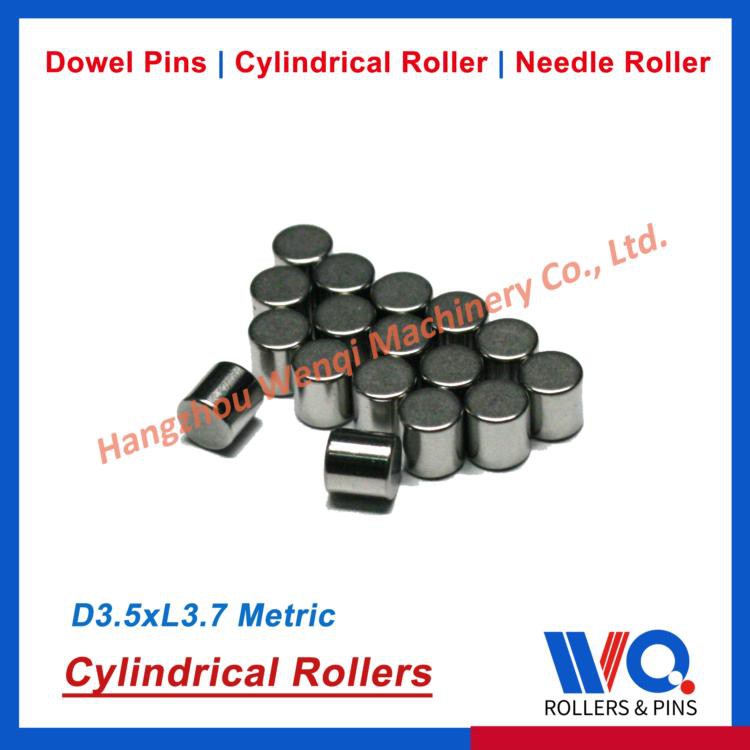
A positioning pin is a part that can participate in limiting the degree of freedom of an object. It has certain applications in some mechanical motion equipment and is mainly used to determine the position in two-dimensional space. Positioning pins, with the workpiece hole as the positioning reference, participate in limiting the object's degree of freedom. They control the linear motion of the object in the three axes of X, Y, and Z and the six free motions of the rotational motion around X, Y, and Z. Spend. In a mold consisting of two or more parts, a pin designed to accurately position two adjacent parts of the mold.
Positioning pins When the machine body is connected by multiple parts, and each part needs to maintain a precise position during processing and assembly, positioning pins should be used for positioning. For example, if the split box body is composed of a machine cover and a machine base, the machining of the bearing holes on it has high precision requirements. Therefore, during design, two positioning pins far apart should be set on the split surface to ensure its processing and assembly accuracy.
The classification and standards of positioning pins can be divided into small positioning pins, fixed positioning pins, replaceable positioning pins, and positioning plugs according to their different structures. Locating pins: Locating pins have a reasonable structure. In order to ensure the accuracy of the relative position between the two parts after assembly, cylindrical pins or conical pins are often used for positioning, so the requirements for the pins and pinholes are relatively high. In order to facilitate the processing of pinholes and pins, the pinholes should be made into through holes whenever possible.
Positioning pin assembly structure
The national standard of positioning pins The national standard of positioning pins is divided into two series of elastic pins: 1. GB879-86 GB879.1/2-2000 DIN1481 ISO8752 standard elastic pin; 2. GB879 JIS2808 toothed elastic pin; 3. GB879.3/4/5-2000 DIN7343 ISO8748 ISO8750 rolled elastic pin; 4. Inch, Japanese, German, American, and other elastic pins; 5. The above product materials can be manganese steel or stainless steel or other customer-specified materials. Specifications φ1-φ50. Cylindrical pin series:1. GB119 DIN6325 cylindrical pin; 2. GB120 DIN797 internal thread cylindrical pin; 3. GB117 DIN19 tapered pin; 4. DIN7978 internal thread tapered pin; 5. Holed pin GB880; Screw tail tapered pin GB881; Pin GB882; The above product materials can be made of carbon steel or stainless steel or other customer-specified materials. Specifications φ1-φ50. Pins are also called positioning pins. Its purpose is the positioning of mold parts. Pins are available in straight and tapered types, and there are also tapping types for each of the above types.
The JIS standard calls it a fixing pin for stamping dies (B5062 straight type only). JIS also includes parallel pins (B1354) and tapered pins (B1352) that are machine parts, but their accuracy is lower than that used in molds. The outer diameter accuracy, surface roughness, and material hardness are necessary conditions for positioning pins. The positioning pin should be gently pressed into the hole for use. The holding force consists of the surface pressure and friction obtained due to elastic deformation when the positioning pin is pressed into the hole. Therefore, when using positioning pins, the relationship between the outer diameter accuracy of the positioning pin and the hole accuracy is very important. Since the pin diameter needs to be pressed into the hole diameter, the hole diameter must be slightly smaller. If it is raw material and quenched material, there will be a difference if the hole diameter holding force and the pressing force of the positioning pin are not changed. Therefore, the raw material should reduce the pore diameter by 10 μm, and the quenched material should reduce the pore diameter by about 5 μm. Please see the basic usage method of positioning pins. Press the two positioning pins into the plate, taking care to avoid misalignment.
Positioning as far away as possible will help improve accuracy. Indicates the relationship between the positioning pin and the hole. The relationship between hole diameter and depth is such that the length of the locating pin should be twice the diameter of the locating pin. The smaller one should be the same length as the diameter, and the larger one should not exceed 3 times the diameter. If the depth of the hole is less than the diameter of the locating pin, the positioning accuracy will deteriorate; if it exceeds 3 times the diameter of the locating pin, it will be difficult to perform accurate hole processing. Positioning two parts is the basic method of using positioning pins.
However, there are also cases where it is used through three plates. The holes on the middle plate are free-sized holes to avoid the positioning pins. Since the positioning pin is not fixed in the middle, the positioning accuracy is poor. Due to the above reasons, positioning pins cannot be used for more than 4 boards in terms of accuracy. Generally, straight column locating pins are commonly used, but sometimes tapered locating pins are also used. The tapered positioning pin may loosen due to vibration and impact, so please pay special attention to it. Also, using the dowel to support pressure from the sides is not the purpose of the dowel itself, so don't hold out too much hope that it will adequately serve its purpose. Please refer to the size of the connecting screw used to determine the diameter of the locating pin. Generally, use the same diameter as the screw size or one diameter larger than the screw size.