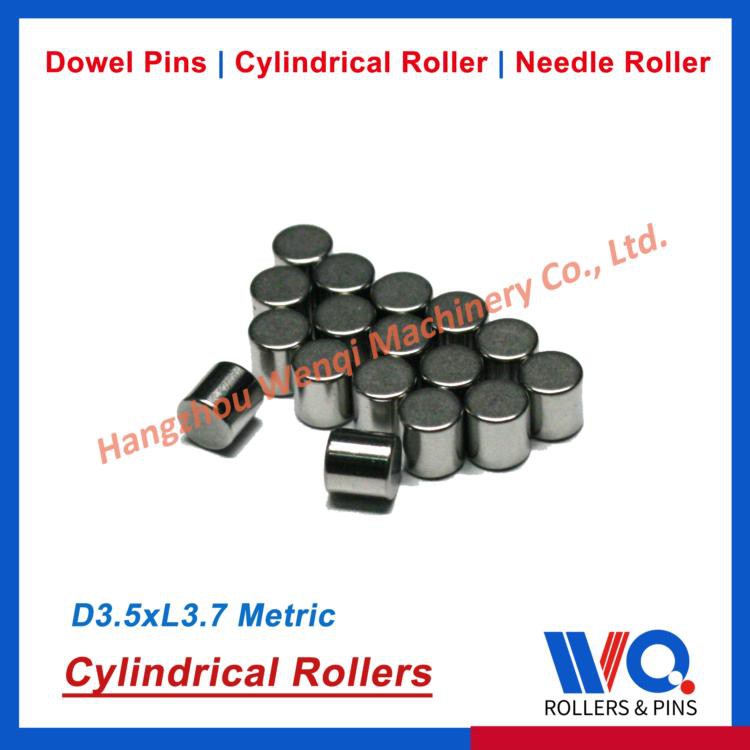
Locating pins are very common for mechanical designers, and they are very useful. Let me introduce the locating pin first. The locating pin is actually an informal name. The strict name is a pin, which is used to precisely limit The position and coordinates of the connected parts of the parts, usually only the two parts that need to be matched, need to be added.
The positioning pin also has a second function, which is to quickly replace and install the spare parts that require precise positions and are frequently replaced (some are called wearing parts). If there is no positioning pin, it is quite troublesome. It is difficult to find out the original location.
Locating pins can be divided into many types according to their classification. Since they are called pins, they are generally round and have a diameter of the main body. There are many kinds; for example, one end is round, and the other end has screw teeth. This is a guide pin, which is commonly used for two parts that are often separated and combined. Of course, some relative position tolerances are too large, and it is difficult to ensure that the round one can be inserted into the pin.
This kind of pin can be used with a tapered pin; the head is also round, but it is relatively small, and it is easy to guide the product of the hole deviation. There are also some products whose upper diameter is larger than the lower one, and the lower one is smaller than the upper one. A small flange is added in the middle. This difference in shape can be applied to different occasions, but the purpose is the same, that is, the two parts are often separated.
Let's talk about its tolerances below. Normal pins have a connection function, and tolerances can be adjusted according to requirements. There are three kinds of fits; one is clearance fit, and this kind of fit is that no matter how big the hole is, the shaft can be easily inserted. It can even slide, and some people call it sliding matching.
Corresponding to it is interference fit, that is, no matter whether the hole is made of upper tolerance or lower tolerance shaft, there is no way to put it in. This kind of fit is relatively rare in the era when metal is king, and it is generally used to match the temperature. For assembly, such as more precise shafts and bearings, it is necessary to heat the bearings and freeze the shafts to fit.
The other is a transition fit; that is, when the hole reaches the upper tolerance and the shaft reaches the lower tolerance, it is a clearance fit; otherwise, it is an interference fit. This kind of matching pin and pinhole is its classic application. To achieve the desired function of the product, but also to facilitate installation, of course, this involves a processing problem.
Generally speaking, the processing of national holes is done with circular cutters, and in the process of making the cutters, in order to make them more versatile, the production basis is generally based on the integer diameter. The beating of the hole is only made into a positive tolerance; of course, the tool is worn out.
However, during the production process of the shaft (pin), we will first place the bar material. Generally speaking, there will be a certain tolerance in the bar material during the forming process, but in the processing link, generally either circular grinding or lathe processing, it will only be a bar. The material becomes finer, and it is easy to make a negative tolerance, which forms a natural matching relationship.
Finally, I would like to tell you how to install the pins. There are always four ways to install them. The first is side pins. It is mainly to place one or several pins around the parts to limit them. The parts only control the surface in two directions. , Some people think that the amount of finishing is too large, and only one side pin is made in each of the two directions.
The second is the blind pin, which means that the pinhole does not penetrate when it is made with a tool. As long as two pinholes are made and two points are set on a line, the part positioning can be realized. This is also widely used, and the disadvantage is that the two parts are separated. The holes and hole positions must be accurate; otherwise, there is no way to install them.
The third is the shape of the pin. In order to position the parts, a nail hole is made on one board, and a groove is made on the other board. The width of the groove is equal to the diameter of the pin, and they are matched;
The fourth type is what we said above, the guide pin, which can more effectively deal with the two-piece positioning of the activity.