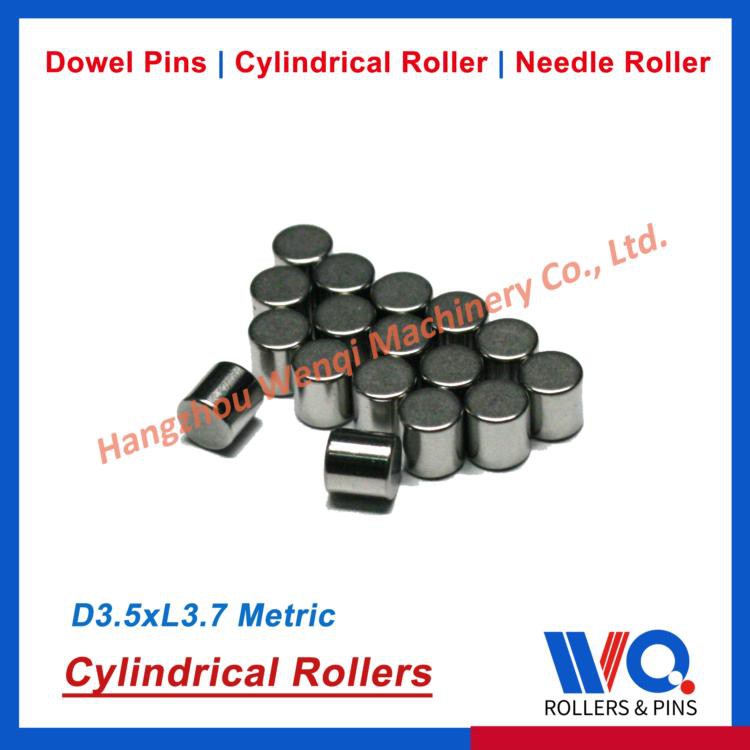
Having a firm grasp on a metal's mechanical properties will help you determine which material will suit your application as you shop for fasteners like dowel pins.
Mechanical Properties of Metals: A List
Some of the most important mechanical properties to understand are:
Hardenability: The ability of a metal to reach a desired hardness.
Machinability: A measurement to determine how easily a metal can be cut.
Corrosion Resistance: A metal's ability to resist corrosive or deteriorating elements or environments.
Within those properties, several other properties become imperative to understand. Those include:
Tensile Stress: A type of stress that pulls a material in opposite directions.
Tensile Strength: The maximum amount of tensile stress a material can withstand.
Elasticity: A metal's ability to bounce back to its original shape after experiencing a deforming force.
Plastic Deformation: The permanent deformation (but not breakage) of a metal.
Yield Strength: The point at which a metal's elastic behavior gives way to plastic deformation.
Shear Stress: The stress of a force that could cause a metal to break or slice along its planes.
Ductility: A measurement of a metal's ability to undergo plastic deformation without breaking.
Toughness: A combination of a metal's ductility and tensile strength.
Let's take a deeper look at each of these properties to better understand how they work together to illustrate a metal's behavior.
Hardenability
Hardenability is the potential of a metal to reach a desired hardness-a measurement of a metal's resistance to plastic deformation, which is influenced by the material's tensile strength and elastic properties. To determine if a metal is hardenable to a desired degree, it is important to understand how hardness is measured.
Hardness
To attain hardness, a metal must be heated to an austenitic phase, which is a high-temperature solid phase where atoms rearrange, and then quickly cooled to a martensitic phase, which is a hardened state of steel that develops when the austenitic steel cools down too quickly for the atoms to return to their original configuration. The optional heat treatment known as tempering enables the metal's hardness to be adjusted to various degrees.
The hardness of a metal can be measured with a variety of tests, with the most common being the Rockwell, Brinell, Vickers, and the Knoop tests. Each test result is displayed as a number followed by the test abbreviation, although some tests add other components to the final results, like the applied force value, a representation of the type of material, and the time that elapsed during the test. For each test, a lower hardness number represents softer materials, while higher numbers represent harder materials.
Machinability
Machinability is a fairly subjective metal property that indicates the degree to which a metal can be easily cut. It cannot be exactly measured (unlike hardness) because outside factors influence this characteristic. These variables include the metal-cutting material, the temperature of the material and the surrounding air, the usage of cutting fluids, the speed of the cutting, and more.
But AISI saw that there was a need for a framework that would serve as a foundation for machinability determination. This led to the creation of the Machinability Index, which uses a standard formula to rate the machinability of various metals.
Machinability Ratings
The process involved comparing the machinability of each metal to that of B1112 cold-drawn steel, which was assigned a Machinability Rating (MR) of 1 and served as the standard metal. AISI examined various metals against the speed at which B1112 could be cut with a specific tool life in order to provide a rating.
The resulting MR for each metal is expressed as a percentage, with B1112 receiving 100%. If a metal scores below 100%, it is harder to machine than B1112. If it scores above 100%, it is easier to machine. For example, 1095 carbon steel has an MR of around 45% because of its carbon content. Aluminum 6061, on the other hand, has an MR closer to 270%.
Corrosion Resistance
Corrosion is when a metal deteriorates and loses density because it cannot withstand the interaction between itself and the external environment. Corrosion resistance is a metal's ability to resist that interaction, usually due to its alloy makeup, a protective coating, or both.
Oxygen, liquids, temperature, atmosphere, chemicals, electrical currents, dirt, and debris are common external variables that affect corrosion. Each of these components has the ability to serve as a channel for other parts, which may result in more interactions. The metal's environment will also have an impact on how corrosion behaves; for example, a metal immersed in seawater will not be as resistant to corrosion as one that is left outside or kept in a chemical plant. Since different metals offer different kinds of protection, it's critical to understand what kind of corrosion resistance a metal needs to function successfully in its intended application.
Several popular alloys show good resistance to corrosion in both ambient and natural environments:
· 300 series stainless steel is not corrosion resistant on its own; it needs a coating, passivation, or plating to exhibit resistance. However, 316 is known for its corrosion resistance in saltwater environments. 400 series stainless steels exhibit good corrosion resistance to mild natural elements.
· Other metals that offer good corrosion resistance to natural elements include 360 and 464 brass, which work well in saltwater environments.
· Finishing processes, platings, and coatings that provide corrosion resistance include but are not limited to rust inhibitors, anodizing aluminum alloys, black oxide, chromate conversion coatings, electroplating, zinc or manganese phosphate, color phosphate, hot-dip aluminum, and zinc electroplating.
Other Properties to Consider
Other important properties that communicate the behavior of metal include shear stress, strain, and strength; ductility; and toughness.
Wenqi Machinery offers a range of products in these different types of metals that are suitable for a wide variety of applications. Contact our sales team or browse our range of products for more information.