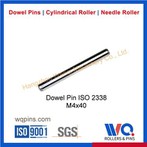
Classification of alignment pins and pin-hole fit types
As we all know, according to the different tolerances and fits, the fit of positioning pins and pin holes can be divided into three types, namely clearance fit, transition fit and interference fit.
The positioning pin needs to be used for precise positioning and cannot be disassembled frequently, so in general, transition fit is selected for the cooperation between the positioning pin and the pin hole. So how should the transition fit between the shaft and the hole be selected?
1. Select the benchmark system
Under normal circumstances, we should give priority to the base hole system. Choosing the base hole system can reduce the amount of processing labor, reduce the specification and number of fixed value tools and measuring tools, and thus obtain better economic results.
Second, select the tolerance level
IT5: It is used for conditions where the requirements for fit tolerances are very small and the requirements for shape tolerances are very high. This kind of tolerance level can make the fit properties relatively stable.
IT6: The mating surface has higher uniformity requirements, which can ensure a relatively high mating property, and the use is stable and reliable.
IT7: Widely used in general machinery, the application conditions are similar to IT6, but the accuracy is slightly lower.
IT8: It belongs to medium precision in mechanical manufacturing.
After comparison, it can be seen that it is more appropriate to choose IT6 and IT7. At the same time, considering the principle of process equivalence, it is better to choose IT7 for the hole and IT6 for the shaft.