Q: What is the definition of each product and what is the difference between them?
A: Rollers, dowel pins, and needle rollers are all mechanical parts that are cylindrical in shape. Although these products are different, the names are sometimes used interchangeably.
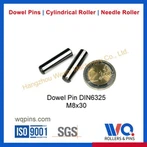
A "dowel pin" is a mechanical fastener that is used to connect several components of an assembly. A pin can function as a shaft, pivot, hinge, jig, or fixture. Typically, a jig is employed to guide a tool as it operates on the apparatus or to hold a workpiece in place. Pins are frequently used to hold or locate parts.
"Roller" implies that the part moves (rolls) when in use. Generally a roller acts as a bearing, supporting a load along its outer diameter.
"Needle" or "needle roller" implies that the length is significantly longer than the diameter. The part is acting as a rolling element.
Q: What are the most common materials used for rollers, dowel pins and needle rollers?
A: Because of its exceptional wear characteristics, strength, and high hardness, bearing-grade chrome steel is often utilized for pins and rollers. This steel is known as 52100 (US), 100Cr6 (Europe), SUJ2 (Japan), and GCr15 (China), all of which are essentially identical.
Stainless steel is used for improved corrosion protection. Austenitic 300 series stainless steel (e.g., 304) offers better corrosion resistance but must be supplied (and therefore processed) in a harder condition (if hardness is required), as it cannot be heat treated; hardness can only be increased through cold working.
Q: How are dowel pins and rollers produced?
A: The raw material for dowel pins, rollers, and needle rollers for bearing grade chrome steel parts is usually supplied in coil wire form. The pieces are roughly chopped to length. The pieces can be tumbled in a big barrel to create this condition if the steel pin or roller just needs a small end radius or break edge.
This processing in batches is quite effective. Large end chamfers or radiuses can be added to the steel pin or roller during the cutting process if such is the final configuration. The steel pin or roller's end radius or chamfer is typically added as a separate stage.
The item is ground to almost its final diameter using a centerless grinding method. After the pieces have been heat treated, a quench and temper procedure is usually performed. To create the steel pin or roller to the necessary precision, one or more end grinding and centerless grinding processes are carried out, depending on the needed tolerances for diameter and length. The process is often finished with polishing and tumbling.
Throughout the manufacturing process, a number of tests are performed to confirm the accuracy of measurements and craftsmanship. High levels of precision in form and dimension are usually needed for pins and rollers.
For some customers and applications, extraordinary quality assurance is required. Wenqi Machinery has high-speed sorting machines that perform 100% inspection for diameter and/or length.
Q: What are the common end configurations for dowel pins and rollers?
A: A steel dowel pin or roller's two ends are often chosen based on how and where it is manufactured, as well as its intended use. A narrow end radius is the most cost-effective configuration if there are no assembly-related issues. During the barrel tumbling step of a basic batch process, this feature can be added.
If the steel dowel pin or roller is assembled into a hole with limited clearance or interference, a greater end radius or chamfer is typically utilized. If so, a different machining procedure is required. In certain sections, the ends of the pieces have a purpose, hence a more precise geometry is needed. Once more, this feature is created by adding a distinct turning process.
Q: Do all dowel pins and rollers have a straight OD?
A: Parts used as rolling elements in bearings are sometimes built with a crowned diameter, although most steel pins and rollers are characterized by an outer diameter with great precision. A precise diameter is needed for a crowned OD along the steel roller's length in the middle, while each end requires a diameter drop. Because of its design, the steel roller cannot operate as a rolling bearing member with greater strains at its ends.
Wenqi Machinery leverag advanced equipment, craftsmanship, and high-quality materials, specializes in the production of needle rollers, cylindrical rollers, dowel pins and universal joints.
Offering customization services, we have developed thousands of customized products for our clients over the years. We regularly upgrade our production equipment and processes to meet the evolving needs of our customers, fostering mutual growth.Welcome to contact us for more information!